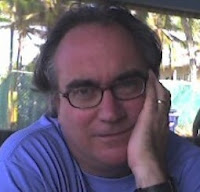
Seamus Deane, born in Derry, is a professor of literature at Notre Dame. He is the author of several critical studies of Irish literature (among other scholarly works) and several volumes of poetry. In 1996, at the age of 56, he caused a minor sensation in the world of Irish letters with the publication of his first novel, Reading in the Dark. I confess that when I bought my Vintage paperback copy and added it to the Stack, the title and what I knew of Deane led me to believe that it would be something along the lines of a literary memoir or maybe a novel about a young Irishman reading (in the dark); I had tried to track down a copy of his out-of-print A Short History of Irish Literature (another book Celtic Revivals: Essays in Modern Irish Literature is still available).
As it turns out this is not a novel about the sort of young man who reads much, although the protagonist's reading habits are not mentioned. His family definitely wouldn't encourage a lot of time for education, and particularly not about the family past. A twisted past it is, full of violence and betrayals stemming from the Troubles. I won't go into the specifics that hold up the labyrinth of shame and loathing that imprisons the family of the unnamed narrator, the plot (that is, the story of dark deeds of the past slowly and incompletely revealed) is interesting and complex but the real business of the novel is not to entertain us with lurid story but rather to meditate on the costs of collective and individual guilt to generations of families. The young boy himself is set up one day by a sadistic police sergeant who drives him around deliberately making him look like an informer, a casual bit of malice that blights the boy's life for years, but this is far from the worst of it for him and his already-marginalized family. Even when the sergeant returns years later to tearfully apologize the emotional atmosphere barely registers this ripple of contrition. The burdens of the past, and the lies that past forces on the boy's family, are much worse.
For that matter, the deep dark family secrets themselves are never revealed exhaustively. That too would be beside the point, as these people have suffered not from their own decisions but from the dark current of injustice that has maimed not only them, the "guilty" ones, but everyone else in their hopeless, paranoid community. Even the dignity of family loyalty is denied to the exploited and the poor.
The writing, meanwhile, is first-class, sustaining a lyrical tone and keeping the narrative focused on the gradual unravelling of history. It is a novel that does not wander one pace away from the story. Using the boy's relationship with his emotionally shattered mother as a broad, unifying allegory of his Irish Catholic identity makes for elegant symbolism, one of the hardest things to do in a socially-conscious novel. Very satisfying.
Showing posts with label Troubles. Show all posts
Showing posts with label Troubles. Show all posts
Saturday, October 4, 2008


Monday, March 17, 2008
Hard Boiled Irish
As my St. Patrick's Day contribution I want to write about a few recent novels that I would describe as Hard Boiled Irish. Hard Boiled Irish can be variously seen as the fictional counterpart to the Harrowing Autobiography, an enduring Irish specialty, or perhaps as a reflection of the less heroic or romantic context of late 20th century Irish politics. Certainly there is a finely-honed noir sensibility after a century of literature engaged with The Troubles. The Irishman as literary rebel has always coexisted with the Irishman as social rebel, and both types draw on deeper cultural elements that create alternate possibilities to Anglicization.
I have to start by mentioning two books from the big bad 1950s, first Brendan Behan's Borstal Boy, his memoir of his incarceration after getting involved with the IRA in Liverpool in 1939 at the age of 16 (he had gone there looking for work). The reputation of the book is that it is another representative of the grim history of English depredation, but the book is far from didactic or even political. The teenager is briefly held at a hard prison where inmates are segregated by religion and IRA prisoners are hazed, and he shows the intense social pressure to make sacrifices from more hard-core nationalist prisoners. He is eventually sent to a rural reform school for boys.
But the surprise of the book is the abiding positive spirit that the young Behan displays. He is also unfailingly compassionate in his descriptions of people. Most of all, he has a fine gaelic-inflected patois. Listening to the speech of a tough-guy Paddy circa 1940 is one of the pleasures of reading the book. At the Irish Writer's Museum I saw postcards that Behan had sent to his brother in ireland while triumphantly touring the States (he's in LA doing the town with Harpo Marx). His repeated insistence that there's no reason to worry, he's not losing his touch with the folks, does not seem ironic even as he using his Irish gift of language to cut a swath through North America.
Borstal Boy was published in 1958, and the other book that I would mention from that time is J. P. Donleavy's The Ginger Man, originally published in 1955. Sebastian Dangerfield is an Irish-American studying at Trinity College, although we join him pretty much at the end of the line when it has been so long since he applied himself that he can no longer pass the exams. He can still brawl in taverns, run out on his rent, and "put the boot in" his long-suffering girlfriend as he anticipates a big inheritance from his rich, dying father back in America. The novel is a wonderful (and very dark) satire, examining among other things stereotypes about Irish identity (and the IRA is nowhere in sight).
The latter-day Hard Boiled Irish I want to mention aren't as funny as the 50s classics. They are, however, representative of a very sturdy and strong root of noir in contemporary Irish fiction. Brian Moore is a Belfast-born novelist who has spent most of his career in North America writing a long series of novels on Irish and Catholic themes, the best-known one might be The Lonely Passion of Judith Hearne. His short novel Lies of Silence (1990) is a thriller, a tense hostage situation as the IRA attempts to force a man to drive a car bomb in Belfast. A pointed message of the book is the extent to which nationalist fighting in Northern Ireland has become the province of an impoverished, marginalized few; the prosperous professionals in middle-class residential areas mostly couldn't care less about this old vendetta. The setup of the IRA men spending the night with the hostage bourgeois is cinematic.
Grittier (and not an IRA novel) is Eamonn Sweeney's Waiting for the Healer (1997). The Healer is a glass made up of all the porter left in the bottoms of glasses at the pub, given in the morning to a local alcoholic in exchange for, say, fetching the paper. In the dirt-poor ghetto where Paul Kelly is from the old men are in the square waiting for the healer early in the morning. He has fled this bleak world for England where he is successfully managing restaurants. The structure here is classic: Kelly must face down both his own demons and the dark forces of his homeland after his brother is murdered.
Finally I would mention Sean O'Reilly's The Swing of Things (2004), a more sympathetic IRA novel that nonetheless also sees the "hard men" as anachronistic, corrupt, and doomed. O'Reilly is the most ambitious of these writers in terms of Irish wordplay, and his conceit of a man with a history of involvement with the IRA in the North trying to save himself by attending college (and the pubs of Temple Bar) in Dublin is rich with possibility. It's a little high-concept, but well worth reading: it's a pleasure to see a young Irish writer step up to the plate and take a swing.
I have to start by mentioning two books from the big bad 1950s, first Brendan Behan's Borstal Boy, his memoir of his incarceration after getting involved with the IRA in Liverpool in 1939 at the age of 16 (he had gone there looking for work). The reputation of the book is that it is another representative of the grim history of English depredation, but the book is far from didactic or even political. The teenager is briefly held at a hard prison where inmates are segregated by religion and IRA prisoners are hazed, and he shows the intense social pressure to make sacrifices from more hard-core nationalist prisoners. He is eventually sent to a rural reform school for boys.
But the surprise of the book is the abiding positive spirit that the young Behan displays. He is also unfailingly compassionate in his descriptions of people. Most of all, he has a fine gaelic-inflected patois. Listening to the speech of a tough-guy Paddy circa 1940 is one of the pleasures of reading the book. At the Irish Writer's Museum I saw postcards that Behan had sent to his brother in ireland while triumphantly touring the States (he's in LA doing the town with Harpo Marx). His repeated insistence that there's no reason to worry, he's not losing his touch with the folks, does not seem ironic even as he using his Irish gift of language to cut a swath through North America.
Borstal Boy was published in 1958, and the other book that I would mention from that time is J. P. Donleavy's The Ginger Man, originally published in 1955. Sebastian Dangerfield is an Irish-American studying at Trinity College, although we join him pretty much at the end of the line when it has been so long since he applied himself that he can no longer pass the exams. He can still brawl in taverns, run out on his rent, and "put the boot in" his long-suffering girlfriend as he anticipates a big inheritance from his rich, dying father back in America. The novel is a wonderful (and very dark) satire, examining among other things stereotypes about Irish identity (and the IRA is nowhere in sight).
The latter-day Hard Boiled Irish I want to mention aren't as funny as the 50s classics. They are, however, representative of a very sturdy and strong root of noir in contemporary Irish fiction. Brian Moore is a Belfast-born novelist who has spent most of his career in North America writing a long series of novels on Irish and Catholic themes, the best-known one might be The Lonely Passion of Judith Hearne. His short novel Lies of Silence (1990) is a thriller, a tense hostage situation as the IRA attempts to force a man to drive a car bomb in Belfast. A pointed message of the book is the extent to which nationalist fighting in Northern Ireland has become the province of an impoverished, marginalized few; the prosperous professionals in middle-class residential areas mostly couldn't care less about this old vendetta. The setup of the IRA men spending the night with the hostage bourgeois is cinematic.
Grittier (and not an IRA novel) is Eamonn Sweeney's Waiting for the Healer (1997). The Healer is a glass made up of all the porter left in the bottoms of glasses at the pub, given in the morning to a local alcoholic in exchange for, say, fetching the paper. In the dirt-poor ghetto where Paul Kelly is from the old men are in the square waiting for the healer early in the morning. He has fled this bleak world for England where he is successfully managing restaurants. The structure here is classic: Kelly must face down both his own demons and the dark forces of his homeland after his brother is murdered.
Finally I would mention Sean O'Reilly's The Swing of Things (2004), a more sympathetic IRA novel that nonetheless also sees the "hard men" as anachronistic, corrupt, and doomed. O'Reilly is the most ambitious of these writers in terms of Irish wordplay, and his conceit of a man with a history of involvement with the IRA in the North trying to save himself by attending college (and the pubs of Temple Bar) in Dublin is rich with possibility. It's a little high-concept, but well worth reading: it's a pleasure to see a young Irish writer step up to the plate and take a swing.
Subscribe to:
Posts (Atom)